


Hiking in Corsica
Hiking in Corsica reveals the true soul of the Isle of Beauty, a land where rugged mountains, fragrant maquis shrubland, and a pristine coastline blend harmoniously. This prime destination for mountain hiking offers exceptional routes, from the legendary GR20 to the coastal paths of Cap Corse, passing through glacial valleys and chestnut forests.
Be aware that each Corsican hiking trail tells a unique story, blending exceptional natural heritage with authentic island culture. This land of contrasts allows hikers of all levels to discover breathtaking landscapes, from perched villages to wild coves, in a preserved Mediterranean environment.
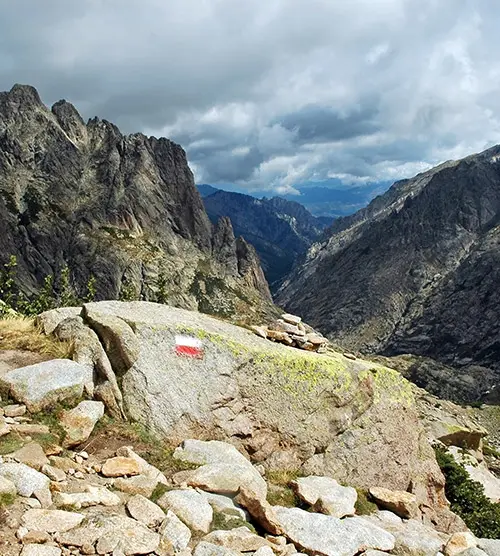
Iconic Hiking Trails in Corsica
Mare e Monti: The Art of Combining Sea and Mountain
It is worth noting that the Mare e Monti trail is one of the most beautiful alternatives to the GR20 for discovering the exceptional diversity of Corsican landscapes. This long-distance hiking trail, 120 kilometers long, connects Cargèse to Calenzana, crossing the island from west to east.
The unique feature of this route lies in its ability to showcase all of Corsica’s ecosystems in a single hike: rocky coastline, Mediterranean maquis, laricio pine forests and granite peaks.
Imagine that this moderate Corsican hike allows you to appreciate the authenticity of mountain villages like Évisa, Ota or Serriera, true witnesses of the traditional island way of life.
The Mare e Monti stages are dotted with refuges and guesthouses that perpetuate Corsican hospitality, offering hikers meals prepared with local products: AOC cured meats, sheep’s cheeses, chestnuts and maquis honey.
That being said, the panoramas revealed by this trail are among the most spectacular in the Mediterranean. The Spelunca gorges, the Aïtone forest with its natural pools, the Calanques of Piana, a UNESCO World Heritage Site, and the peaks of Bavella combine to create a breathtaking natural landscape.
This diverse landscape makes the Mare e Monti a condensed version of all the riches that hiking in Corsica can reveal.Sentier des Crêtes and Haute Route Corsica
Furthermore, the Corsican high route follows the island’s ridges, revealing exceptional panoramas on both Mediterranean sides. This network of high-altitude trails, accessible to experienced hikers, traverses the mountainous spine of Corsica from Monte Cinto to the Bavella Needles.
The significant elevation changes and technical sections require excellent physical condition, but reward the efforts with breathtaking views.
It should be noted that these high mountain trails reveal an exceptionally rich endemic fauna and flora.
The Corsican mouflon, emblem of the island, frequents these protected areas where it coexists with the golden eagle and the bearded vulture.
The high-altitude vegetation has unique characteristics such as the Corsican barberry or the Corsican hellebore, species that are not found anywhere else in the world.
The fact is that the physical and technical demands of these courses require careful preparation and appropriate equipment.
THE weather conditions Conditions can change rapidly at altitude, requiring constant vigilance and mastery of navigation in adverse weather. This alpine dimension of Corsican hiking often surprises walkers accustomed to continental terrain.Mare a Mare: Transversal Crossings of the Island
Moreover, the Mare a Mare trails offer three cross-country routes across Corsica, allowing you to discover the island in its entirety, from the eastern coast to the western coast.
These routes of varying difficulty adapt to different levels of practice, from the Mare a Mare centre (more technical) to the Mare a Mare sud (more accessible) via the Mare a Mare nord which crosses the mythical Agriates desert.
These hiking trails reveal the extraordinary geological diversity of Corsica, from the granite formations of the south to the crystalline schists of Cap Corse, passing through the limestone of the Bonifacio plateau. This geological variety translates into contrasting landscapes that unfold along the way: high-altitude glacial lakes, verdant valleys, arid plateaus, and rugged coastlines.
It must be said that the cultural appeal of these routes is equal to their natural beauty. The villages along the way boast remarkable architectural heritage, with their Pisan Romanesque churches, Genoese towers, and traditional dry-stone houses. This heritage dimension significantly enriches the hiking experience by revealing the millennia-old history of Corsica.
GR20: The Ultimate Challenge of Hiking in Corsica

Full Course: A Technical and Physical Challenge
As an example, the GR20 represents the culmination of Corsican hiking and one of the most demanding trails in Europe. This legendary 180-kilometer route crosses Corsica from northwest to southeast, following the island’s main ridge line.
The 16 official stages, spread between Calenzana and Conca, require about fifteen days of walking for trained hikers.
Nevertheless, the GR20‘s reputation for difficulty should not discourage motivated hikers, but it does require serious physical and technical preparation. Rocky sections, scree crossings, and significant elevation changes (sometimes over 1500 meters in a single stage) demand advanced technical skills and endurance.
This alpine requirement makes the GR20 a true personal challenge for lovers of long-distance hiking.
That said, the rewards offered The efforts made along this legendary trail are more than compensated. The landscapes revealed are among the most spectacular in the Mediterranean: the glacial cirques of Restonica and Golo, the Bavella Needles, high-altitude lakes with emerald waters, and ancient forests of Corsican pine. This succession of exceptional natural vistas justifies the international renown of the GR20.Accessible Variants and Steps
That said, the GR20 in stages allows less experienced hikers to discover the most beautiful sections of the trail without committing to the entire route. Certain sections, such as the crossing of the Bavella Needles or the ascent of Monte Cinto, can be done as day hikes from accommodation bases.
The GR20 mountain huts are essential stops that contribute to the legend of the trail. These mountain shelters, managed by the Corsican Regional Natural Park, offer services tailored to the needs of hikers: dormitory accommodation, meals, and food sales.
The friendly atmosphere in these shelters creates bonds between walkers of all nationalities, united by the common passion for long-distance hiking.
It should be noted that several variations allow the route to be adapted according to weather conditions or the technical level of the participants. These alternatives, carefully marked and documented, offer safe escape routes when conditions become difficult on the main route.Logistics and Accommodation on the GR20
Despite the fact that the GR20 crosses unspoiled wilderness areas, the logistical organization of the route benefits from infrastructure adapted to the needs of hikers. Staffed mountain huts offer full services during the open season (May to October), while sheepfold guesthouses perpetuate traditional Corsican hospitality in an authentic setting.
Booking accommodation is essential during peak season (July-August) due to the high volume of hikers on the trail. This popularity reflects the allure of this legendary route, but requires meticulous planning to ensure a successful outing.
The periods of May-June and September-October offer an ideal compromise between favorable weather conditions and moderate visitor numbers.
Moreover, the supply of food and equipment can be done in several mountain huts equipped with shops, saving hikers from having to carry all their supplies for fifteen days of walking. This modern logistical flexibility preserves the wild spirit of the route while ensuring a safe adventure. Coastal Hikes and Trails of Corsica
Customs Officers' Path and Maritime Heritage
It’s worth noting that the coastal path runs along the entire Corsican coastline for over 1,000 kilometers, revealing the full diversity of the island’s coastal landscapes. This network of historic paths, once used by customs officers to patrol the coast, is now one of the most beautiful coastal hiking trails in the Mediterranean.
Imagine that each section of this trail reveals a different atmosphere: the vertiginous cliffs of Cap Corse, the fine sandy beaches of the eastern coast, the granite coves of the south, and the wild coast of the west. This geomorphological diversity is explained by the island’s rich geology and the millennia-long action of marine erosion on rocks of different types.
For this reason, the coastal fauna and flora are of exceptional naturalistic interest. Peregrine falcons nest in the cliffs, cormorants frequent the rocky islets, while the halophytic vegetation reveals remarkable adaptations to saline conditions.
This ecological richness makes the Corsican coastline a natural laboratory for understanding Mediterranean ecosystems.Scandola Nature Reserve and the Calanques of Piana
It’s worth noting that the Scandola Nature Reserve, a UNESCO World Heritage Site, can only be explored by boat or via difficult-to-access coastal paths. This strict protection preserves an exceptionally rich marine and terrestrial ecosystem, home to the osprey, an emblematic bird of prey of the Mediterranean.
The Calanques of Piana are one of the most photographed sites in Corsica, with their red granite formations sculpted by erosion. The trails that crisscross this lunar landscape reveal breathtaking panoramas of the Gulf of Porto and offer insights into the geological processes that shaped these extraordinary landforms.
Please note that access to certain sections requires a good level of physical fitness and a head for heights, as the trails sometimes traverse exposed ledges above the sea. This aerial aspect adds a spectacular dimension to the hike while demanding caution and concentration from walkers.Cap Corse and Agriates Desert
Furthermore, Cap Corse offers exceptional coastal hikes in a pristine environment where dense maquis shrubland, abandoned villages, and Genoese towers intertwine. The coastal path reveals wild landscapes dotted with secret coves accessible only on foot, true havens of peace far from the summer crowds.
The Agriates Desert, despite its name, is home to typical Mediterranean vegetation and some of the most beautiful beaches in the Mediterranean. The trails that cross this protected area lead to the beaches of Saleccia and Lotu, jewels of white sand and turquoise waters that rival the most beautiful tropical destinations.
It is important to note that these coastal hikes require particular attention to weather conditions, as sea breezes can make some sections tricky. Checking the forecast and adjusting your schedule to the current conditions are essential precautions to fully enjoy these exceptional landscapes.
Preparation and Equipment for Hiking in Corsica

Physical Condition and Specific Training
The fact is that physical preparation is of paramount importance for a successful hike in Corsica, particularly on technical trails like the GR20 or high-altitude traverses. The island’s mountainous terrain presents significant elevation changes and varied landscapes that engage different muscle groups.
Progressive training over several months is essential to confidently tackle the most demanding courses.
Specific training should prioritize mountain outings with a backpack to accustom the body to the demands of long-distance hiking. Muscle-strengthening exercises, particularly for the lower limbs and abdominal muscles, prepare the body for prolonged exertion and the unstable terrain characteristic of Corsican trails.
That said, the mental aspect of preparation should not be neglected. The ability to manage effort over time, to accept temporary discomfort, and to maintain motivation in the face of difficulties is a key factor in success. This mental preparation develops gradually through varied and increasingly challenging hiking experiences.Technical Equipment and Safety
As a guideline, hiking equipment should be adapted to the specific terrain of Corsica and the Mediterranean climate. Hiking boots are the most important item: they must provide good ankle support on rocky ground while effectively wicking away moisture in the hot summer climate.
The choice of backpack depends on the duration and type of hike planned :
- 20-30 litre bags for day hikes;
- 40 to 60 litre bags for multi-day treks with overnight stays in mountain huts;
- 60 to 80 litre bags for fully self-supported treks with bivouac.
This gradation allows the load carried to be adapted to the specific constraints of each type of hike while preserving the comfort and efficiency of walking.
Nevertheless, safety equipment should never be neglected, even on the easiest trails.
Kit FIRST AIDAn emergency whistle, survival blanket and satellite phone (for areas without coverage) constitute a minimal safety arsenal that can prove vital in the event of an incident.Navigation and Orientation in Corsican Terrain
Despite the fact that the main Corsican trails are well-marked, mastering mountain navigation remains essential for safe travel. Weather conditions can quickly reduce visibility, making trail markers difficult to follow. The ability to orient oneself using a map and compass, supplemented by the judicious use of GPS, is a fundamental skill.
The 1:25,000 topographic maps from the French National Geographic Institute (IGN) remain the standard reference for hiking in Corsica. These detailed documents reveal the terrain, water sources, mountain huts, and emergency evacuation routes. The ability to correctly read these maps and correlate them with the observed terrain is acquired through regular practice and is essential for safety.
Furthermore, modern navigation apps provide invaluable assistance, particularly for route tracking and geolocation in emergencies. These technological tools complement, but never replace, traditional navigation techniques, which remain reliable in all circumstances. Seasons and Climate: Choosing the Ideal Time to Visit
Corsican Spring: Nature's Rebirth
It’s worth noting that spring in Corsica (April to June) is one of the most beautiful seasons for hiking, particularly on mid-altitude trails and coastal routes. Nature awakens after its winter slumber in an explosion of colors and fragrances that characterizes the flowering of the maquis.
Mild temperatures and moderate rainfall create ideal conditions for walking.
This season reveals Corsica in its most generous aspect, with lush vegetation and waterfalls fed by melting high-altitude snow. The natural pools of the Restonica, the Spelunca gorges, and the Purcaraccia basins offer their most beautiful aquatic displays. This abundance of water in spring contrasts sharply with the relative aridity of the Mediterranean summer.
Believe it or not, the drawbacks of spring remain minor: relative weather instability with the possibility of showers, persistent snow cover on the high ridges above 2000 meters, and the late opening of some mountain huts. These minor inconveniences are largely compensated for by the exceptional beauty of the landscapes and the mild climate.Mediterranean Summer: High Season and Climate Challenges
That being said, the Corsican summer (July-August) sees the majority of tourist traffic but imposes significant climatic constraints on hikers. High temperatures, sometimes exceeding 35°C in the plains, and the aridity characteristic of the Mediterranean climate require adjustments to hiking schedules and routes.
Strategies for adapting to summer heat include very early starts (before dawn), extended breaks during the hottest hours, significantly increasing fluid intake, and choosing shaded or elevated routes. Coastal trails benefit from refreshing sea breezes, while forest paths offer the protection of leafy canopies.
However, the peak summer season offers undeniable advantages: stable weather conditions, maximum accessibility to all high-altitude trails, full opening of mountain huts and services, and a vibrant social scene along the routes. This summer activity contributes to the unique atmosphere of hiking in Corsica during the warmer months.Golden Autumn: Season for Connoisseurs
It’s worth noting that autumn in Corsica (September-November) appeals to experienced hikers thanks to its ideal weather conditions and moderate crowds. Temperatures become mild again, summer storms become less frequent, and the unique light of this season enhances all the landscapes.
This period is often the ideal time to attempt long-distance trails such as the complete GR20.
Autumnal vegetation reveals lesser-known aspects of Corsican nature. Chestnut trees are adorned with vibrant colors in the Castagniccia region, strawberry trees glow red in the maquis, while the first snows dust the highest peaks. This autumnal palette of colors considerably enriches the aesthetic experience of hiking.
Moreover, this season coincides with the traditional harvest period: chestnuts, olives, and grape harvesting in the vineyards of Patrimonio and Ajaccio. Hikers can thus combine natural exploration with immersion in local culture, sometimes even participating in the seasonal activities that still shape life in mountain villages.
FAQ
Hiking in Corsica
For moderate trails and coastal routes, spring (April-June) and autumn (September-November) offer optimal conditions with mild temperatures and abundant natural beauty. Summer (July-August) is suitable for experienced hikers who can tolerate the heat, requiring very early morning starts.
For high-altitude trails like the GR20, June to September is best when the snow has melted and the mountain huts are open. Winter limits options to lower altitudes and coastal paths.
The full GR20 route remains reserved for experienced hikers with excellent physical condition and technical mastery of rocky terrain. However, some stages can be completed in a day by intermediate-level hikers: Vizzavona-Capanelle, Col de Bavella-Usciolu, or Haut-Asco-Carozzu.
It is strongly recommended to first gain experience on less technical trails such as the Mare e Monti or sections of Mare a Mare before considering the GR20.
Equipment must be adapted to the Mediterranean climate and rocky terrain: hiking boots with rigid soles and high tops, reinforced sun protection (cream, hat, sunglasses), breathable and quick-drying clothing, a large water reserve (3L minimum per person), and a complete first aid kit.
For the GR20: lightweight mountaineering equipment, a sleeping bag suitable for cool nights at altitude, a stove and cooking gear for stages without services. Hiking poles are essential on rocky terrain.
The main Corsican trails (GR20, Mare e Monti, Mare a Mare) are well-marked and can be hiked independently by experienced hikers. However, a local guide adds considerable cultural and natural value, revealing local history, fauna, flora, and traditions.
For less frequented trails, off-trail variants or winter hikes, professional guidance becomes highly recommended or even essential for safety.
Corsica is home to numerous endemic species: the Corsican mouflon (the island’s symbol), the Corsican nuthatch, Bedriaga’s lizard, the Corsican violet, and the Corsican hellebore. The maquis reveals its characteristic scents: myrtle, immortelle, rockrose, strawberry tree, and mastic tree. At higher altitudes, observe the golden eagle, the bearded vulture, and the high-altitude vegetation.
The wetlands are home to Hermann’s tortoises and Corsican salamanders. This exceptional biodiversity justifies the regional natural park status and requires absolute respect for the environment.
On the GR20, staffed mountain huts offer meals and supplies from May to October, allowing you to lighten your pack. However, it’s advisable to carry emergency supplies and check opening times.
Natural springs are plentiful, but their flow varies seasonally: bring water purification tablets as a precaution. On other trails, plan your resupply stops in the villages along the way. Always carry at least 3 liters of water per person per day during hot weather, and more if you are exposed to prolonged sun.
Dried fruit, energy bars and freeze-dried foods form the basis of a hiker’s diet.
