
Planning a ferry trip to the “Island of Beauty” is the first practical step in your Mediterranean vacation. Choosing to travel by boat rather than by plane offers the advantage of bringing your own vehicle, traveling without luggage weight restrictions, and immersing yourself in the vacation atmosphere as soon as you step on board.
In 2026, the market for ferry service between mainland France and Corsica is dominated by several major carriers with complementary offerings. To provide modern, quieter ships with a smaller carbon footprint, shipowners have invested heavily in upgrading their fleets’ energy systems.
The variety of departure ports along the Mediterranean coast ensures great flexibility when planning your road trip. These crossings are well-suited to the needs of families traveling with luggage as well as to the travel plans of motorcyclists and RV travelers.
It is important to note that ferry service to Corsica operates under two distinct frameworks: on the one hand, the Public Service Delegation (DSP) ensures territorial continuity year-round from Marseille; on the other hand, the open market operates from Toulon or Nice, providing healthy competition that benefits passengers.
To book the best-suited crossing at the best price in 2026, it is recommended that you carefully compare the onboard services, night crossing schedules, and the terms for changes or cancellations. This comprehensive overview provides a detailed analysis of the options offered by the various ferry companies connecting the mainland to Corsican ports for this season.
Long-established ferry companies on the France-Corsica routes
Two major players play a central role in maritime transport to Corsica, accounting for the vast majority of passenger and cargo traffic. With a long-standing presence along the Mediterranean coast, these companies are distinguished by their unique identities, their networks, and the profiles of their vessels.
To better serve passengers on these crossings, onboard services and cabin amenities have been significantly modernized in recent years. However, your choice of one company or the other depends primarily on your departure point on the mainland and your destination on the island.
Corsica Linea: the public service contractor operating out of Marseille
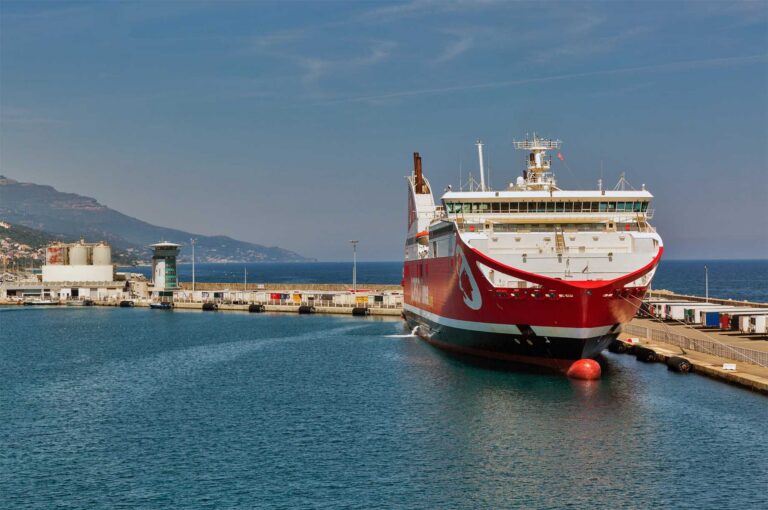
Corsica Linea plays a vital role in ensuring territorial continuity, drawing on a rich maritime heritage in the Mediterranean. Based exclusively at the major seaport of Marseille, this company—known for its red-and-white ships—offers daily direct crossings to Ajaccio, Bastia, Île-Rousse, and Porto-Vecchio.
Committed to the ecological transition, Corsica Linea is implementing its decarbonization plan with the introduction of state-of-the-art ships powered by Liquefied Natural Gas (LNG). Since the voyages take place mainly at night, passengers enjoy the comfort of private cabins, allowing them to travel in comfort and arrive at their destination refreshed in the morning.
The onboard dining areas showcase the island’s culinary heritage by offering specialties made with regional AOP-certified products. Renowned for its strict adherence to schedules and technical reliability, the company is the top choice for crossings to Corsica.
Corsica Ferries: the leader in ferry service from Toulon and Nice
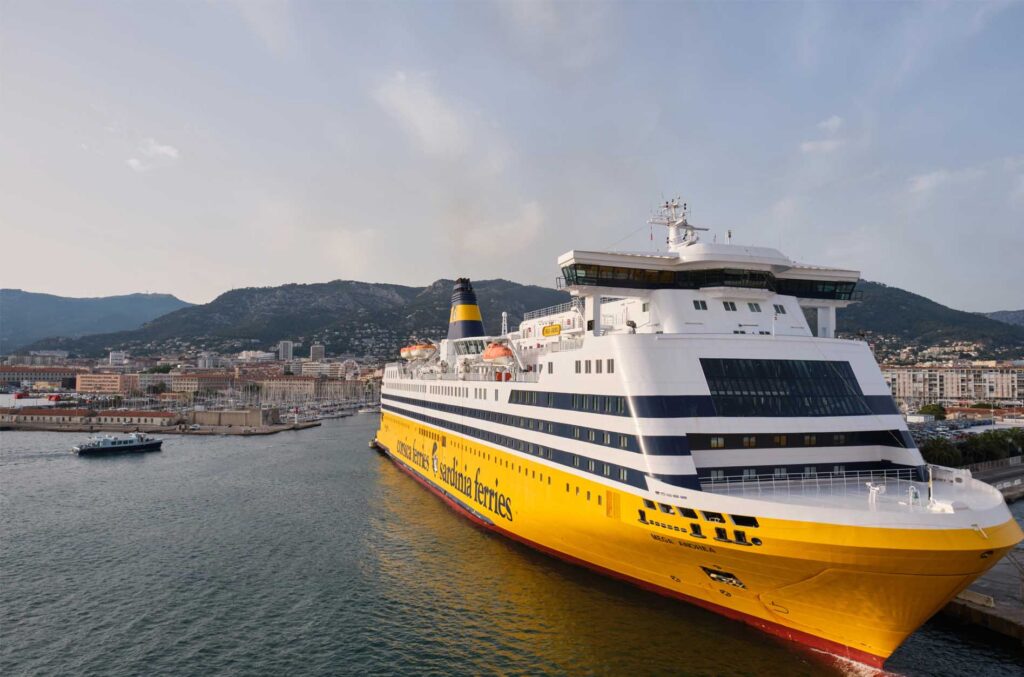
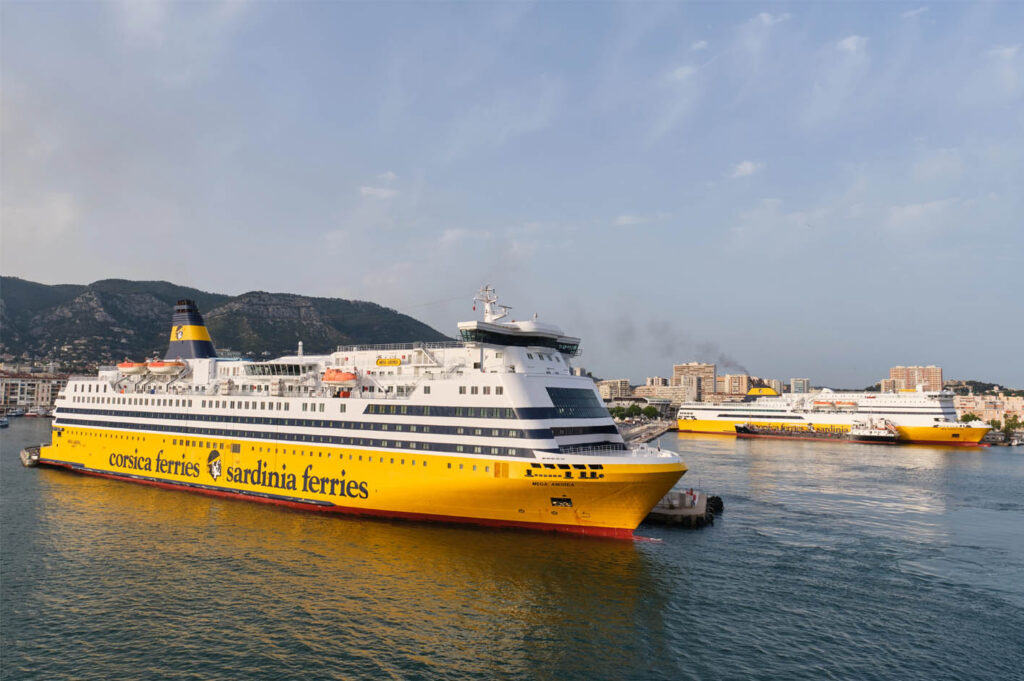
Easily recognizable by the bright yellow color of its fleet, Corsica Ferries has established itself as the leading European-flagged passenger carrier to Corsica. With departures from Nice and Toulon, as well as from the Italian coast, the shipping company offers extensive and regular service.
Crossings take place at a steady pace, alternating between overnight trips with cabins and faster daytime trips to Ajaccio, Bastia, Porto-Vecchio, or Île-Rousse. Despite the crowds and the large number of vehicles transported during the summer, the systematic management of boarding ensures a smooth crossing.
The line is particularly popular with families thanks to its attractive fares, frequent promotions, and a rewarding loyalty program. In addition, pets receive special attention, with dedicated cabins and outdoor areas on the upper decks.
Other Ferry Companies and Alternatives for Traveling to Corsica
In addition to the two main players in the market, several other ferry companies play a key role in improving access to and serving tourists on the “Island of Beauty.” By offering varied itineraries and a different take on ferry travel, these operators prioritize a friendly atmosphere or connections to specific micro-regions.
To avoid summer congestion at major continental terminals, it’s particularly worthwhile to explore these alternative options. A careful analysis of each carrier’s features will help you determine the best option for your travel dates.
La Méridionale: elegance and Marseille’s maritime tradition
A long-standing partner working alongside Corsica Linea to ensure territorial continuity, La Méridionale stands out for the remarkable quality of its hospitality and its intimate atmosphere. With regular service connecting Marseille to Île-Rousse and Ajaccio, its passenger-cargo ships—whose names are inspired by iconic regions and rivers—ensure a pleasant crossing.
A pioneer in environmental protection, La Méridionale has distinguished itself by adopting marine particulate filters and shore power, thereby eliminating polluting emissions during port calls. In addition, the onboard dining experience showcases traditional Corsican cuisine through the use of fresh, locally sourced ingredients.
Thanks to the smaller size of the ships, boarding procedures are smoother, and the evening atmosphere remains peaceful—ideal for resting. This company has thus established itself as the top choice for passengers seeking tranquility, serenity, and impeccable comfort.
Moby Lines: Alternative Routes Departing from Mainland Italy
The Italian company Moby Lines is a particularly popular choice among French vacationers from the eastern part of the country, even though its crossings primarily depart from the Italian ports of Genoa, Livorno, and Piombino.
Throughout the summer, its ships—adorned with famous comic book characters—provide direct service to the port of Bastia. The crossing from Livorno takes just a few hours, making it one of the fastest sea routes to Upper Corsica. On the other hand, this route requires a longer drive to reach the Italian ferry terminals from mainland France.
For many drivers, the very affordable fares offered on these short routes more than offset the costs of fuel and highway tolls. In addition, the ships in the Moby fleet operate regular routes connecting the southern part of the island (Bonifacio) to northern Sardinia (Santa Teresa Gallura), offering a great opportunity to plan itineraries that combine both island regions.
Departure ports on the mainland and arrival ports in Corsica
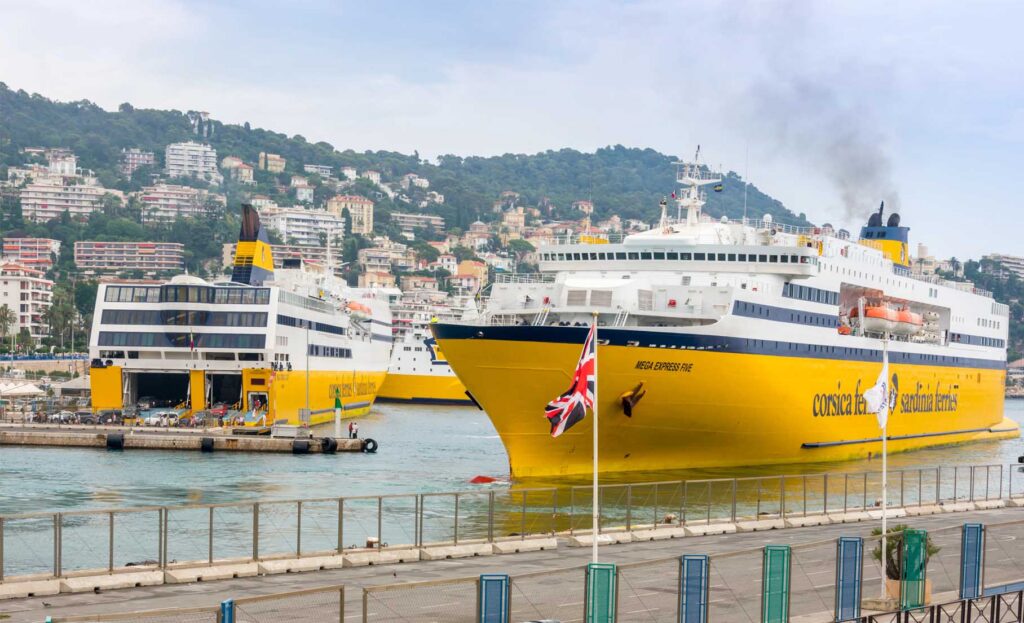
Your choice of mainland port of departure directly determines the duration of the sea crossing and the time spent traveling. In metropolitan France, the Mediterranean coast relies on three major ports to provide regular service to Corsica: Marseille, Toulon, and Nice. Note that each mainland port is equipped with appropriate facilities and direct highway access, simplifying the transport of vehicles to the boarding areas.
On the “Island of Beauty,” Corsican ports are strategically located along the entire coastline to provide direct service to each tourist micro-region. It’s worth noting that the geographic layout of these ferry routes allows you to optimize your itinerary based on the exact location of your vacation destination.
- The Port of Toulon offers the largest number of night and day departures to all Corsican ports;
- The Port of Marseille serves as a hub for public service ferry routes, with guaranteed daily departures year-round;
- The Port of Nice offers the fastest ferry crossing from mainland France to Upper Corsica;
- The ports of Ajaccio and Bastia handle the majority of passenger traffic and feature modern terminals;
- The ports of Île-Rousse and Porto-Vecchio provide direct access without having to cross mountain passes.
To avoid long drives after you disembark, choose a port of arrival that’s right next to your accommodations.
In fact, driving on the island’s road network can be challenging: Corsican roads, though beautiful, are particularly winding and can significantly lengthen travel times during the summer season.
Criteria for Choosing the Right Ferry Company in 2026
Selecting the ideal shipping company requires thorough research, given the wide variety of carriers and rate schedules. Thanks to online booking platforms, in 2026 it will be possible to analyze schedules and services simultaneously in order to choose the most suitable option.
If the fare for the crossing remains a key factor, other factors are just as crucial to the quality of the trip, particularly the level of comfort offered and the flexibility of cancellation policies. Every traveler has specific needs, whether it’s an individual business trip or a family vacation with camping gear.
The type of ship and the amenities on board
The ships providing service to Corsica include traditional ferries, mixed-use vessels, and large cruise ferries. These large ships offer a variety of amenities: a range of dining options, movie theaters, outdoor swimming pools, and safe play areas suitable for children.
Please note that on a nighttime crossing, booking a private cabin with full bathroom facilities is essential for arriving on the island feeling refreshed. On the other hand, for a daytime crossing lasting five to six hours, a reclining, numbered seat in an air-conditioned lounge is more than enough to relax.
You should also know that newer cruise ships now include satellite Wi-Fi on board, allowing travelers to stay connected even in the heart of the Mediterranean. In addition, the level of soundproofing in the cabins is a key factor in ensuring a peaceful night’s sleep, shielding you from engine vibrations and noise.
Transportation conditions for vehicles and luggage
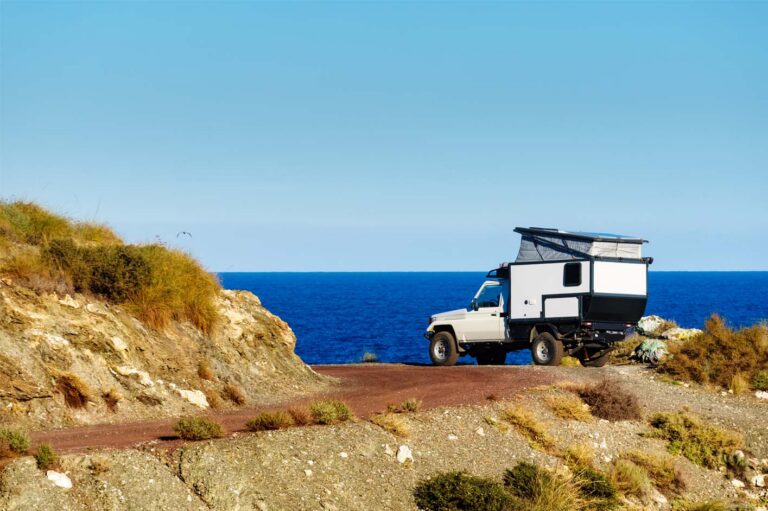
One of the main advantages of traveling by ferry is the ability to bring a car, motorcycle, or RV on board with no luggage weight limit. However, it’s essential to be precise when making your reservation: you must accurately declare the exact size of the vehicle, including any external equipment (bike racks, roof racks).
Any inaccuracy regarding the actual dimensions (height or length) may result in a substantial financial penalty at the time of boarding, or even denial of access if the vehicle decks are full. Furthermore, in response to changes expected in 2026, shipowners have adapted their infrastructure for electric vehicles, notably by providing secure charging stations on board the newest ships during overnight voyages.
Special accommodations are also provided for two-wheeled vehicles, with reinforced securing devices to withstand the movement of the waves. Bringing your own vehicle on board remains the ideal way to explore the island’s hidden treasures at your own pace.
Tips and tricks for booking your ferry crossing at the best price
The cost of the ferry crossing accounts for a significant portion of your overall vacation budget for Corsica. Ferry companies use yield management, a dynamic pricing system that adjusts prices based on ship occupancy rates and the timing of the reservation. To get the best rates and ensure you can book family cabins during peak season, planning ahead is essential.
However, by following a few tips when searching online, you can significantly reduce your transportation costs.
- Book your tickets as soon as winter sales begin to take advantage of the “Early Booking” discounts;
- Choose midweek departures (Tuesday or Wednesday) over Friday and Sunday evenings;
- Sign up for flexible cancellation insurance to change your dates without penalties in case of unforeseen circumstances;
- Join the companies’ loyalty programs for free to earn points and discounts;
- Compare package deals that combine round-trip travel with different ferry companies to optimize your schedule.
To ensure your 2026 travel plans are a success, the ferry network between mainland France and Corsica offers a wide range of comfortable and efficient routes. The various companies operating these routes each have key strengths to meet every need: the reliability of public service with Corsica Linea departing from Marseille, the frequency and flexibility of Corsica Ferries from Toulon or Nice, or the refined ambiance of La Méridionale.
To make the most of your budget, flexibility regarding dates, departure times, and ports of embarkation remains a key advantage. Keep in mind that choosing to depart from Toulon rather than Marseille can sometimes cut the cost in half during peak travel periods. Furthermore, scheduling your crossing outside of school vacation periods ensures extremely attractive rates and a particularly stress-free travel experience.
Finally, by booking early enough and choosing the port of arrival that best fits your itinerary on the island, you’ll be able to enjoy your sea voyage as a truly relaxing getaway off the Mediterranean coast.